

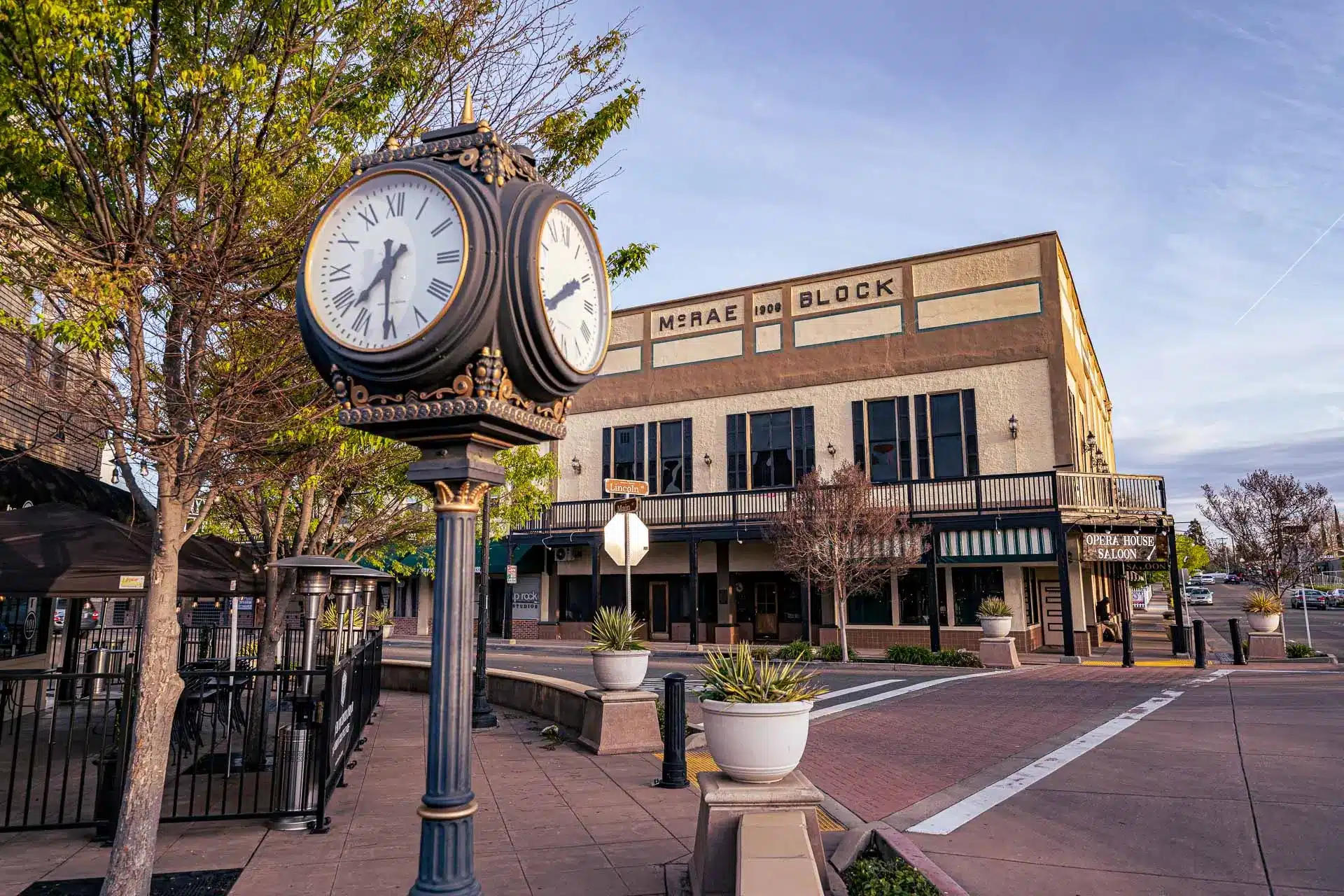
Living in Historic Roseville means much of your week can happen on foot. Vernon Street’s shops and restaurants, the Vernon Street Town Square, Royer Park and the Dry Creek trail sit together at the center of the city, beside the rail yard that built Roseville. The real question is what downtown living usually asks you to give up.
What decides whether Historic Roseville fits you
Most people drawn to downtown living end up asking the same thing: walkable, or room to live — do I have to pick? It’s a fair question. Downtown condos usually give you the walk and take the garage, the storage and any private outdoor space. Subdivisions hand those back and put everything else a drive away.
Four things decide whether Historic Roseville is worth that decision for you.
Vernon Street is a working main street
Vernon Street is the spine of downtown. The City rebuilt eight blocks of it in 2002 with a shade canopy of street trees, early-1900s-style streetlights and benches, and gateways over the street. The goal, in the City’s words, was an attractive, friendly and safe street for downtown customers, business and community events. Today it is lined with shops and restaurants, and it leads straight to the Town Square.
The Town Square is the neighborhood’s gathering place
The Vernon Street Town Square sits next to the Civic Center, with a shaded stage, picnic tables, a fire pit and a sprayground. Every Tuesday in May, June and July (Independence Day excepted), Downtown Tuesday Nights brings more than 100 vendors, live bands, a classic car show and a wine and beer garden. The same stage hosts City concerts and celebrations, including Celebrate Downtown.
Royer Park and Dry Creek are part of the same walk
Royer Park is a 17-acre park the City purchased from the Royer family in 1917. It has mature trees, shaded picnic areas, a stage that serves as a concert venue, lighted tennis courts, pickleball and bocce, and a destination-style playground installed in 2023.
What makes it part of daily life is how it connects. A pedestrian bridge links Royer Park directly to the Vernon Street Town Square. The Taylor Street bridge links it to the Downtown Library. The repositioned Rube Nelson “Ice House” Bridge carries the trail across Dry Creek, part of a continuous six-mile off-street trail from Sierra College Boulevard to Darling Way. The City describes the result simply: downtown neighborhoods, parks, shops, restaurants, the Town Square and the Downtown Library are now linked across Dry Creek.
The railroad is still part of the view
Roseville began as a place called Junction, where the Central Pacific and California Central railroads met. In 1906 the railroad moved its terminal facilities to Roseville, and the town incorporated in 1909. Historic Old Town — Main Street to the north, Pacific Street to the south, Washington Boulevard to the west and Lincoln Street to the east — still carries that history, including a viewing platform over the rail yard. Union Pacific still operates here, and Southern Pacific locomotive No. 2252 stands on static display in honor of the city’s rail heritage.
What this looks like in practice
A Saturday here can start with a walk from the Town Square across the bridge into Royer Park, continue as a loop on the Dry Creek trail, and end with dinner on Vernon Street — without moving the car. From May through July, Tuesday evenings belong to Downtown Tuesday Nights. In the cooler months, the square has its fire pit.
That is the part of Historic Roseville that is easy to love on a visit. The harder question is the home you come back to. Downtown housing has typically asked buyers to trade the garage, the storage and the private outdoor space for the walk. That trade is the one worth questioning.
Where The Belvedere fits
The Belvedere is the only new construction in Historic Roseville, and it is designed to sit on both sides of that line — urban vibe, suburban convenience.
- The garage stays. Every home includes a 2-car garage, pre-wired for an EV.
- The outdoor space moves up. Every home includes a private covered rooftop patio with an outdoor kitchen — standard, not an upgrade.
- Two plans. The Pacific (1,987 sq ft, 3 bed / 3.5 bath) and The Sierra (2,540 sq ft, 2–3 bed / 2.5–3.5 bath).
- Included, not optional. Owned solar, WiFi access points on every floor, quartz countertops, LG appliances, custom cabinetry and matte black fixtures.
The rooftop is the hinge. It turns “walkable” from the thing you gave up space for into the reason you chose the place: the neighborhood around you, and the evening yours.
Eighteen homes. No future phases. More than half are gone.
Frequently asked questions
Where is Historic Roseville?
Historic Roseville is the downtown core of Roseville in Placer County, centered on Vernon Street and Historic Old Town. The City defines Historic Old Town as the area from Main Street to Pacific Street and from Washington Boulevard to Lincoln Street. Royer Park connects to the Town Square by pedestrian bridge.
Is downtown Roseville walkable?
The core pieces are connected for walking and biking. A pedestrian bridge joins Royer Park and the Vernon Street Town Square, the Taylor Street bridge reaches the Downtown Library, and a six-mile off-street trail runs from Sierra College Boulevard to Darling Way. How walkable daily life feels depends on where on that network you live.
What events happen in downtown Roseville?
Downtown Tuesday Nights runs every Tuesday in May, June and July (except Independence Day), with vendors, live bands, a classic car show and a wine and beer garden. The Town Square stage and the Royer Park stage also host concerts and City celebrations such as Celebrate Downtown.
Why is Roseville called a railroad town?
Roseville started as Junction, where the Central Pacific and California Central railroads met. The railroad moved its terminal facilities here in 1906 and the town incorporated in 1909. Union Pacific still operates in Roseville, and Historic Old Town includes a viewing platform over the rail yard.
Is there new construction in Historic Roseville?
The Belvedere is the only new construction in Historic Roseville. It is a fixed community of eighteen homes with no future phases, and every home includes a 2-car garage and a private covered rooftop patio with an outdoor kitchen.
Tour the neighborhood first
The simplest way to answer the walkable-or-space question is on foot. Walk Vernon Street, cross the bridge into Royer Park, then come see the home. Call The Belvedere at 916-580-6398 to plan your visit, or reach NEXT New Homes Group, ERA Powered. See the plans and the rooftop on The Belvedere community page.


